
Designing a Self-Sustaining Landscape with Restrained Geometry and Natural Silence
In modern landscape design, minimalism is often misunderstood as emptiness.
But within the philosophy of the Japanese Zen courtyard, emptiness is not the absence of beauty — it is the highest expression of intention.
Every stone, every ripple in the sand, every shadow cast by a maple leaf exists with purpose. Nothing is excessive. Nothing competes for attention. The result is a space that feels emotionally quiet, visually weightless, and psychologically restorative.
Unlike traditional gardens that rely on dense flower beds, seasonal replacement, and constant pruning, the Zen courtyard operates more like a self-regulating ecosystem. Through the precise composition of gravel, natural stone, moss, restrained foliage, and architectural negative space, even a tiny courtyard can become a living abstraction of mountains, rivers, forests, and silence itself.
More importantly, this approach dramatically reduces maintenance.
Instead of demanding endless labor, the garden stabilizes over time. Stone replaces lawn. Moss replaces thirsty flower beds. Slow-growing sculptural plants replace fragile seasonal blooms.
The courtyard becomes not simply a decorative outdoor area, but a long-term sensory sanctuary — one that quietly evolves while asking almost nothing in return.
The Hardscape Framework: Creating the Infinite Canvas
The true backbone of a Japanese Zen courtyard is not plant material — it is hardscape.
Stone, gravel, shadow, and negative space establish the timeless foundation upon which the entire ecosystem quietly operates.
By replacing large areas of lawn with permanent mineral materials, maintenance drops dramatically while visual serenity increases.
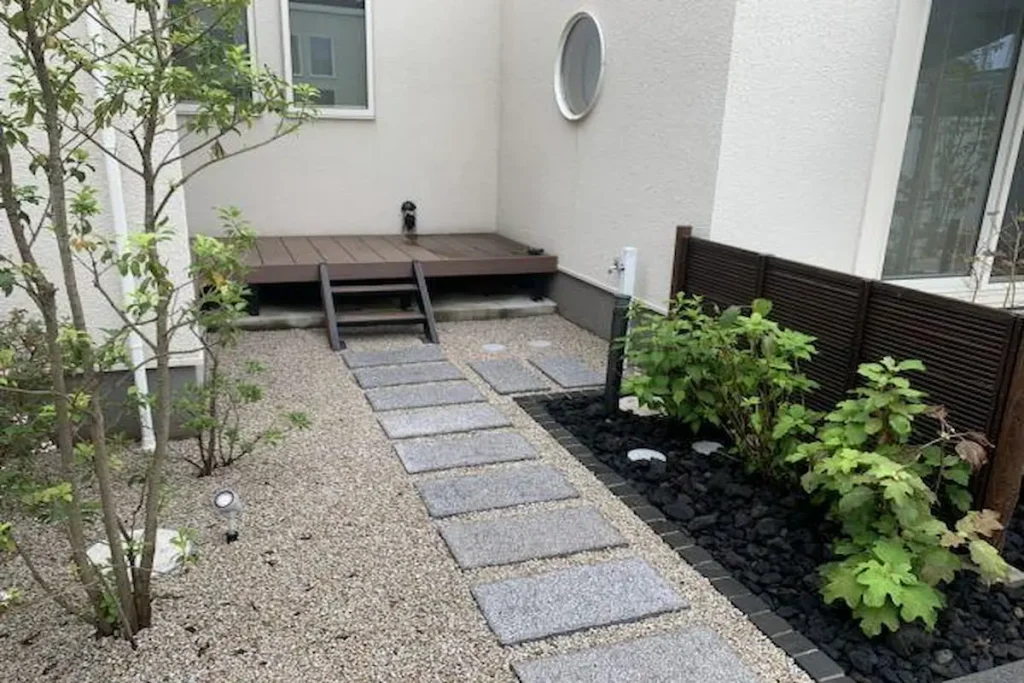
Gravel or Sand — The Frozen River System
Raked gravel patterns symbolize flowing rivers, ocean tides, or drifting wind currents.
The repetitive lines create:
visual rhythm
meditative order
spatial calm
contemplative silence
In a small courtyard, this visual simplicity actually expands perceived space by removing unnecessary visual noise.
Low-Maintenance Advantage
The true secret lies beneath the surface.
Installing a high-density weed barrier beneath the gravel eliminates the vast majority of unwanted growth before it ever begins. This single hidden layer can remove nearly all ongoing weeding labor from the courtyard ecosystem.
Unlike grass lawns that require:
mowing
irrigation
edging
fertilizing
…the gravel landscape remains visually stable for years with only occasional re-raking.
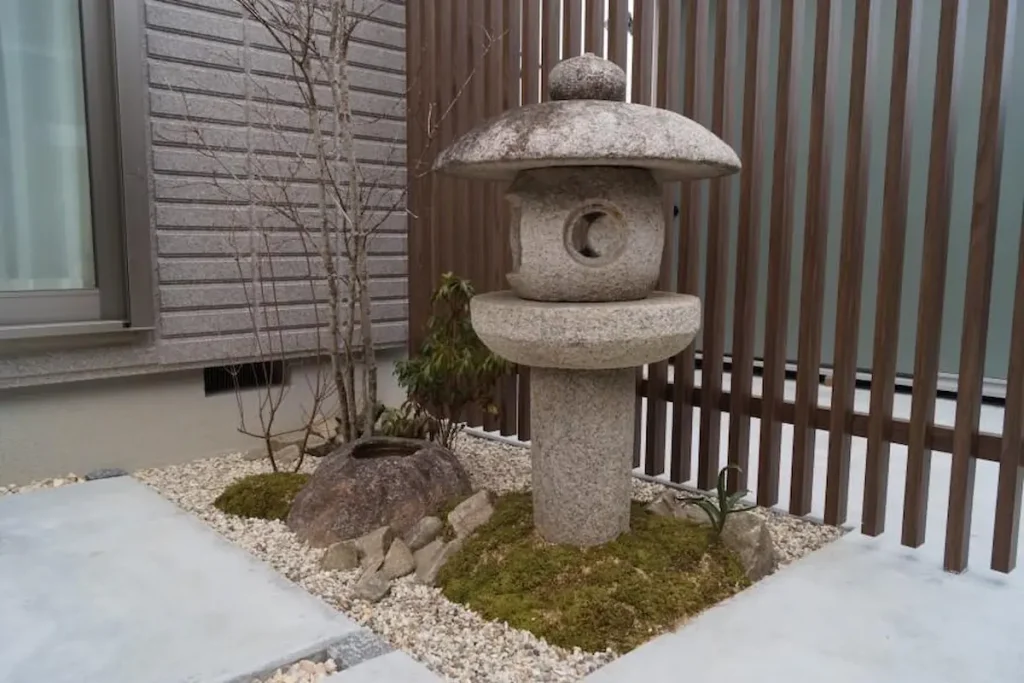
Stone Lanterns & Water Basins — Anchors of Time
Weathered stone lanterns (Tōrō) introduce the quiet poetry of time itself.
Their rough textures and softened edges embody the Japanese philosophy of Wabi-Sabi — the beauty of imperfection, aging, and natural erosion.
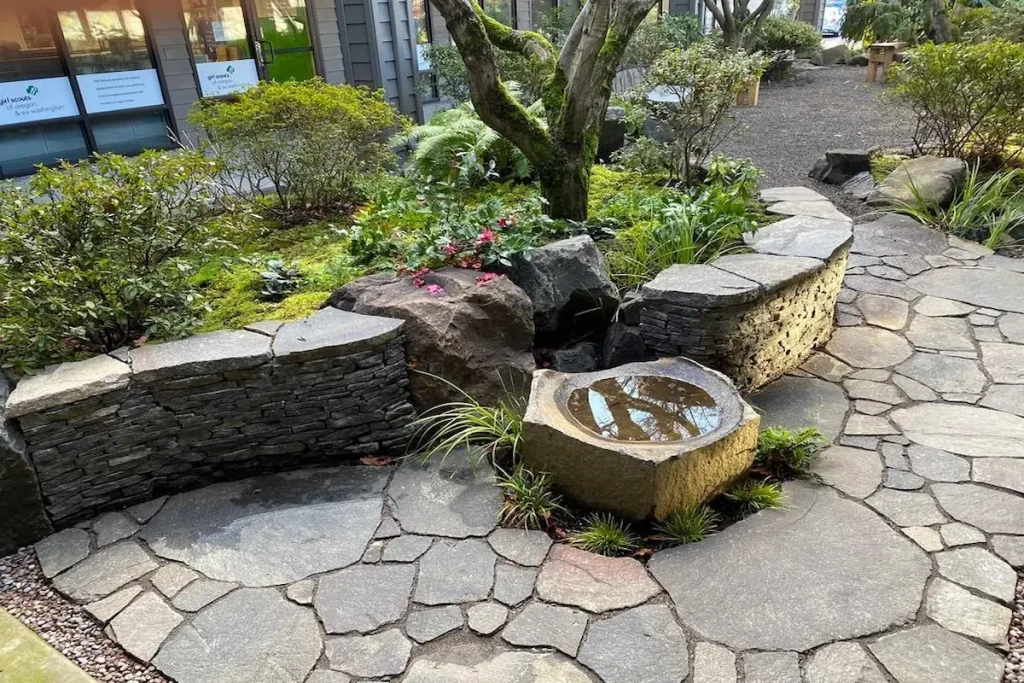
Nearby, a hand-carved stone water basin (Tsukubai) introduces stillness through reflection rather than movement. Even a shallow layer of rainwater can mirror light, sky, bamboo shadows, and maple leaves, visually enlarging the courtyard through subtle illusion.
Low-Maintenance Advantage
Unlike elaborate fountains that demand:
electrical pumps
filtration systems
algae cleaning
seasonal servicing
…a simple static stone basin operates almost maintenance-free.
Rainwater alone often sustains its visual function, allowing water to exist as atmosphere rather than machinery.
Carefully Placed Rocks — Miniaturized Mountain Landscapes
In Zen landscaping, rocks are not decoration — they are mountains.
Traditionally arranged in odd-numbered groupings of three or five, each stone composition suggests natural geological emergence rather than artificial placement.
The key principle:
roughly two-thirds of each stone should appear buried beneath the earth, giving the illusion that the landscape existed long before human intervention.
This creates emotional permanence and natural gravity even within the smallest courtyard footprint.
The Living Layers: Restrained & Sculptural Flora
The plant palette of a Zen courtyard must remain disciplined.
Rather than chasing excessive blooms or seasonal spectacle, the goal is to select slow-growing, evergreen, and highly architectural plants that deepen the atmosphere without disrupting spatial calm.
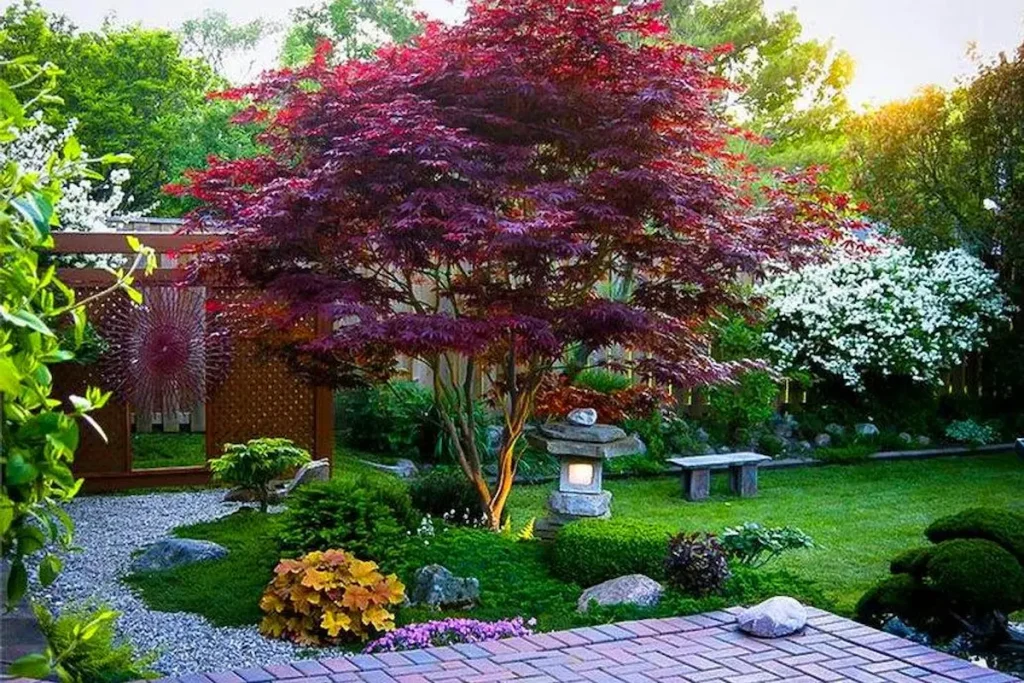
Japanese Maple — The Seasonal Time Axis
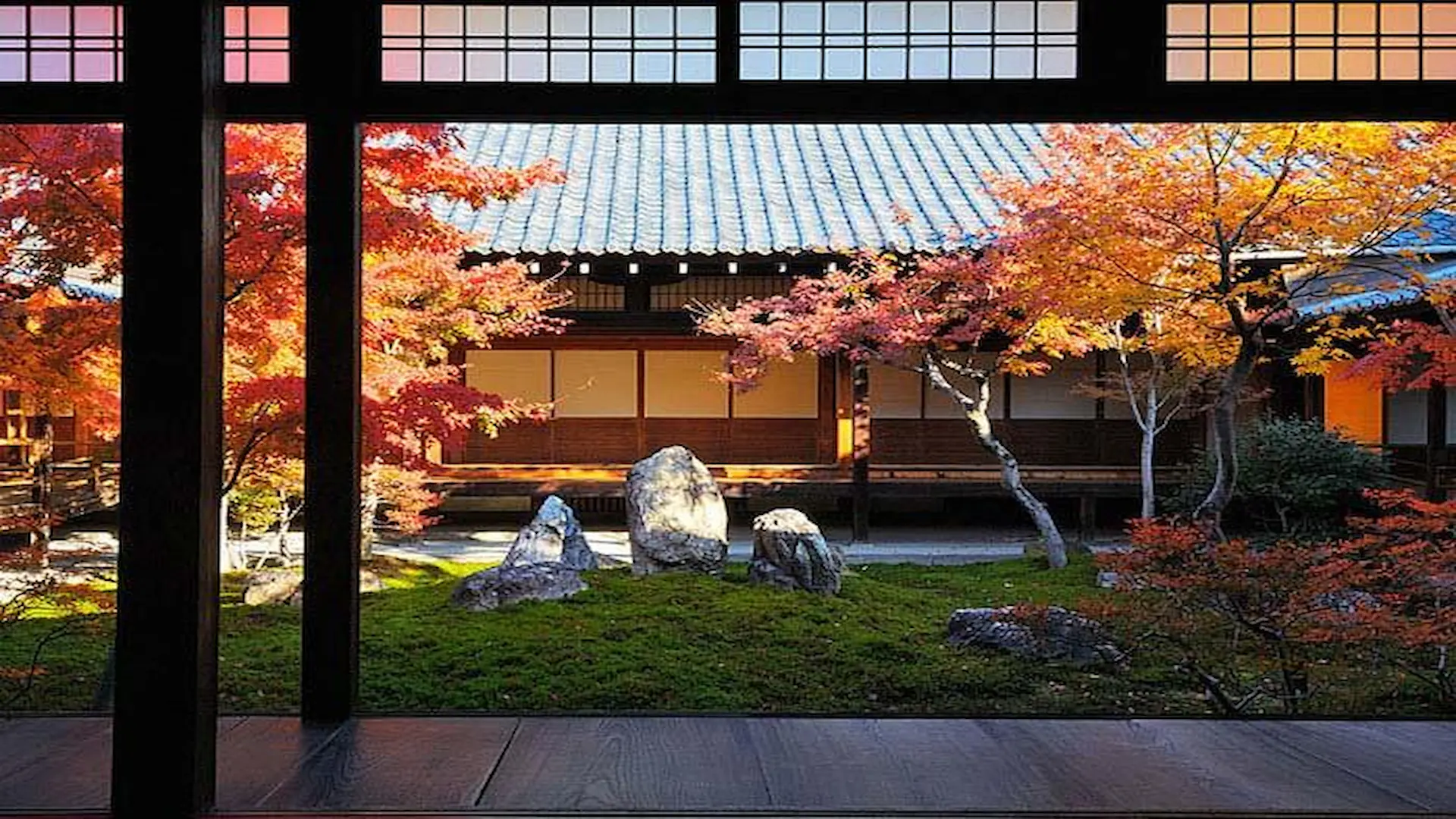
The Japanese maple acts as the courtyard’s singular emotional centerpiece — the lone specimen tree around which the entire visual narrative quietly revolves.
Across the seasons:
spring introduces delicate fresh green foliage
summer deepens into layered shadow
autumn transforms the courtyard into crimson fire
Against pale walls, gray stone, or white gravel, the maple behaves almost like living ink wash painting.
Low-Maintenance Advantage
Compact slow-growing cultivars such as:
‘Bloodgood’
‘Garnet’
naturally maintain elegant proportions for years.
Minimal winter pruning to remove dead interior branches is usually sufficient to preserve their cinematic silhouette.
Unlike fast ornamental trees, they age gracefully rather than aggressively.
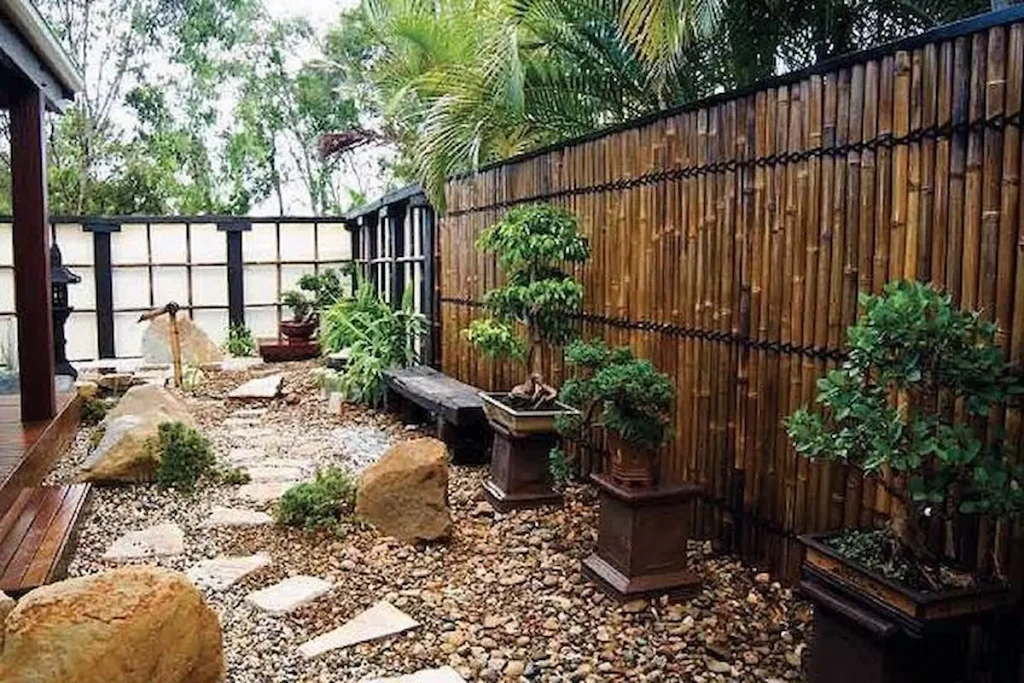
Bamboo — Vertical Silence & Movement
Tall slender bamboo introduces vertical movement into otherwise horizontal courtyard compositions.
Its upward rhythm:
softens walls
expands perceived height
creates privacy
adds gentle kinetic motion through wind
Perhaps most importantly, the sound of bamboo leaves moving in the breeze creates a deeply therapeutic auditory layer rarely found in conventional landscaping.
Low-Maintenance Advantage
Only controlled clumping bamboo varieties should be used.
Installing root barriers or raised containment beds ensures the bamboo remains disciplined and spatially controlled indefinitely.
When managed correctly, bamboo becomes an elegant living privacy architecture rather than an invasive maintenance problem.
The Micro-Climate Solutions: Thriving in the Shadows
Small courtyards often contain difficult environmental zones:
narrow light corridors
permanently shaded corners
humid enclosed walls
Rather than fighting these conditions, Zen gardens embrace them.
The result is a micro-ecosystem where shade itself becomes an aesthetic advantage.
Moss & Ferns — The Forest Floor System
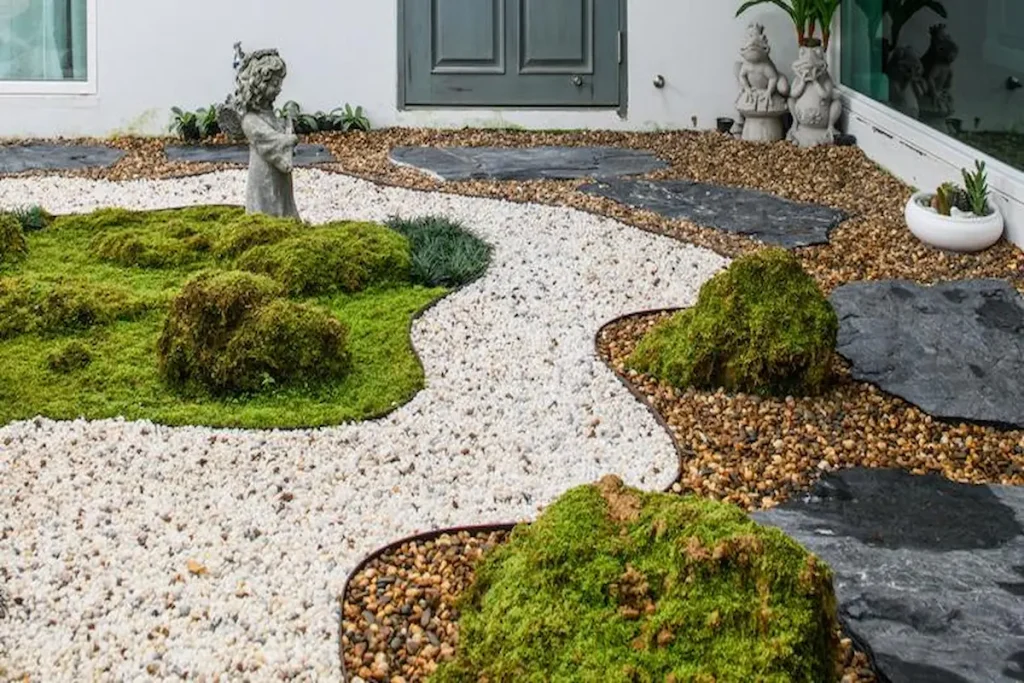
Moss creates the emotional softness that balances stone and gravel.
Spreading gently around rocks and shaded surfaces, it evokes the feeling of ancient mountain forests compressed into miniature form.
Ferns emerging from crevices introduce:
softness
layered texture
organic movement
deep woodland atmosphere
Together, they transform dark neglected corners into the most emotionally immersive parts of the courtyard.
Low-Maintenance Advantage
Unlike flowering plants that deteriorate in shade, moss and ferns naturally thrive in:
humidity
filtered light
cool surfaces
protected microclimates
Once established, they suppress weeds naturally while requiring almost no pruning.
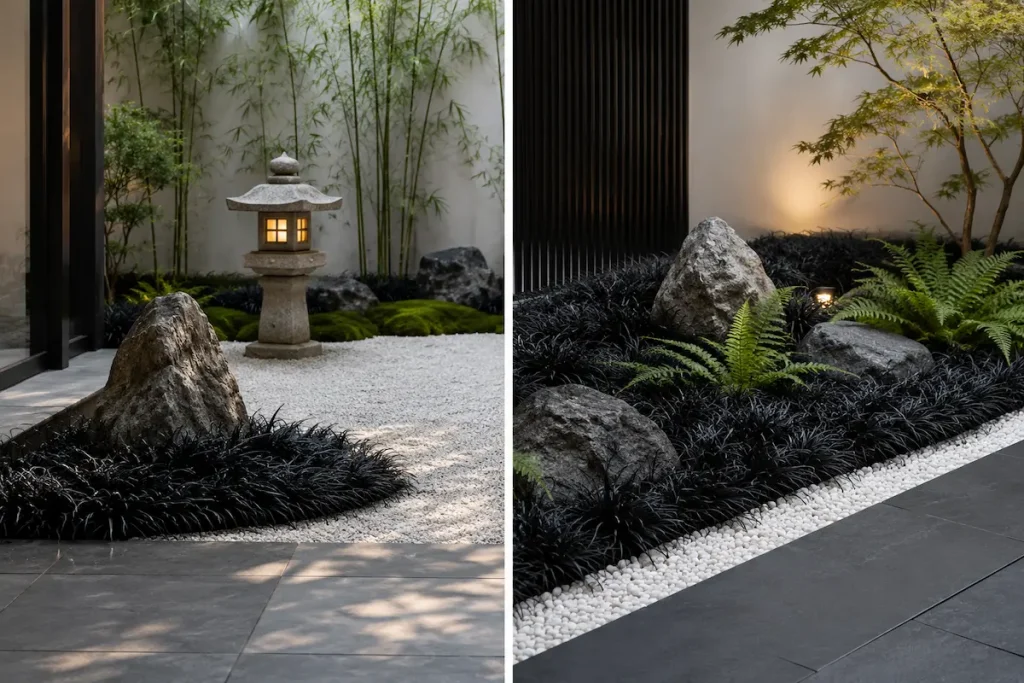
Black Mondo Grass — Minimalist Contrast & Modern Depth
Black mondo grass introduces one of the most powerful tools in minimalist landscape design:
controlled contrast.
Its near-black foliage creates dramatic visual tension against:
white gravel
pale stone
green moss
concrete textures
Even small clusters can elevate an entire courtyard from traditional garden aesthetics into gallery-like modern minimalism.
Low-Maintenance Advantage
Black mondo grass is remarkably resilient.
It tolerates:
shade
humidity
drought
poor soil
Once established, its dense clumping habit naturally suppresses competing weeds while maintaining a clean, uniform texture year-round.
Every element — gravel, stone, moss, bamboo, shadow, silence — exists in quiet cooperation with nature’s own intelligence rather than against it.
This is the deeper philosophy behind low-maintenance Japanese landscape design:
not controlling nature,
but orchestrating stability.
When the gravel settles into rhythm, when the maple casts moving shadows across white sand, when moss slowly embraces stone without intervention, the courtyard ceases to demand meaningless labor from its owner.
It simply exists.
Breathing softly beside the architecture.
And perhaps that is the greatest luxury modern life can offer:
to open the sliding doors, sit beside a cup of tea, and watch a living landscape continue evolving peacefully on its own.